




About Isaac Akintaro
Contents |
[edit] Novel Bomb Proof buildings
[edit] By Isaac Akintaro
Content:
+ Context
+ Engineering Problem
+ Solution
+ Concept
+ Other Applications
+ Advantages and Disadvantages to overcome
+ Action Steps
+ Bibliography
[edit] CONTEXT:
Recent history shows that terrorism has increased in frequency, in impact (cost to human life and infrastructure) and has become more widespread.
We have seen terrorism move from targeting militaries to targeting civilians. Explosives have been an instrument through which acts of terrorism occur and from recent history civilian buildings have been targeted.
There has also been series of accidental explosions within oil & gas plants that have destroyed infrastructure.
Therefore, we have a problem to solve for future homes and buildings, which is to incorporate blast loading into the design of buildings.
[edit] ENGINEERING PROBLEM:
How does a structure behave under a blast load?
Structures experience the spalling effect. This behaves very similar to newton’s cradle.
Newton’s Cradle (Image from Science How stuff works). See link in Bibliography.
Newton’s Cradle (Image from Menger and Rizvi). See link in Bibliography.
Sphere 1 represents the blast load. Spheres 2,3 and 4 represent parts of a wall which compress. Sphere 5 is the inner part of the wall which explodes and can harm civilians. This is known as the spalling effect.
What is needed is something to stop this effect by containing the wall. Essentially we need a protective layer against blast pressure.
[edit] SOLUTION:
We propose the use of a novel bomb-proof material in the cavities between the brickwork and blockwork of homes and buildings.
[edit] CONCEPT:
The novel material is made up of many fabrics and composites. It is commonly known as the ‘flybag’ and was developed at the University of Sheffield (BBC 2015).
It is envisioned to be applied for aircrafts, however I propose it be used for buildings.
The material is flexible and would not interfere with the structural function of the elements around it.
It is envisioned that this fabric would extend around the perimeter of the whole building by existing in between the brickwork and blockwork.
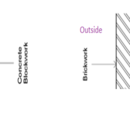
Here is “Zoomed-in” plan detail (in section) of the area around the brick and blockwork of a building:
BEFORE AFTER WITH FLYBAG

(Figure 1 & 2, Author)
[edit] OTHER APPLICATIONS
The Flybag can be applied to sustainable energy. With the reduction in the price of lithium batteries, these batteries can be used to store wind and solar power in homes. The challenge with lithium is that it has a tendency to explode. The Flybag can be used here to provide an anti-explosive covering. Thereby allowing future homes and buildings to be individual ‘power stations’ of renewable energy.
[edit] ADVANTAGES & DISADVANTAGES TO OVERCOME:
This idea would save the lives of many innocent people from terror. It would also prevent economic cost for infrastructure, insurance amongst others.
As said the Flybag can influence other areas such as the widespread use of renewable energy.
The Flybag has been proved successful but once it has been tested in this context, the main challenge is the cost, getting it as low as possible for industrial usage.
[edit] ACTION STEPS:
+Acquire Flybag material.
+Produce a model home and fit the fabric material within the brickwork and block work.
+ Test its bomb proofing capabilities.
+ See how the inclusion of this material can be on an industrial scale if the tests are successful.
[edit] BIBLIOGRAPHY:
+ Institute for Economics and Peace (2016)., Global Terrorism Index 2016 [online]. Available from: doi: http://economicsandpeace.org/wp-content/uploads/2016/11/Global-Terrorism-Index-2016.2.pdf
+ Science How Things Work., [Newton’s Cradle] [digital image]. [Viewed 2nd November 2017]. Available from: https://science.howstuffworks.com/innovation/inventions/newtons-cradle.htm
+ Sonic beam model of Newton’s cradle., [1.1. Case 1] [digital image]. [Viewed 2nd November 2017]. Available from: http://iopscience.iop.org/article/10.1088/0031-9120/51/4/045003
+ BBC (2015)., Aircraft 'bomb bag' limits on board explosion impact [online]. [Viewed 2nd November 2017]. Available from: doi: http://www.bbc.co.uk/news/science-environment-33650713
+ University of Sheffield (2016)., Bomb-proof lining contains explosion in luggage hold of aircraft [online]. [Viewed 2nd November 2017]. Available from: doi: https://www.sheffield.ac.uk/news/nr/bomb-proof-fly-bag-1.483527
Quick links
[edit] Legislation and standards
Fire Safety (England) Regulations 2022
Regulatory Reform (Fire Safety) Order 2005
Secondary legislation linked to the Building Safety Act
Building safety in Northern Ireland
[edit] Dutyholders and competencies
BSI Built Environment Competence Standards
Competence standards (PAS 8671, 8672, 8673)
Industry Competence Steering Group
[edit] Regulators
National Regulator of Construction Products
[edit] Fire safety
Independent Grenfell Tower Inquiry